
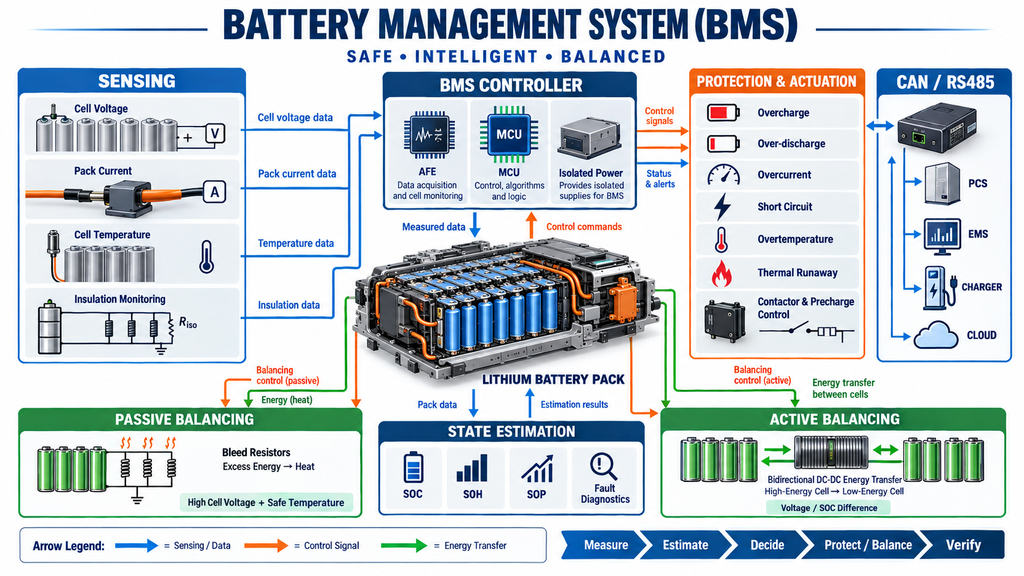
A Battery Management System (BMS) is the intelligent control and protection center of a safe, reliable lithium battery pack. It continuously monitors critical operating parameters, including individual cell voltage, pack current, cell temperature, insulation resistance, and charging or discharging status. Based on these measurements, the BMS estimates the State of Charge (SOC), State of Health (SOH), and State of Power (SOP), enabling the battery system to determine its remaining capacity, degradation level, and available power in real time. When abnormal conditions are detected, the BMS activates protection strategies against overcharge, over-discharge, overcurrent, short circuit, excessive temperature, and potential thermal runaway. It can also control contactors and the precharge circuit to isolate the battery pack safely. Cell balancing is another essential BMS function. Passive balancing uses resistors to dissipate excess energy from higher-voltage cells as heat. It is cost-effective and simple but results in energy loss and is generally more suitable for low-power balancing applications. Active balancing transfers energy from cells with higher voltage or SOC to cells with lower energy through capacitors, inductors, transformers, or bidirectional DC-DC converters. Although active balancing requires more complex hardware and control algorithms, it can improve usable capacity, balancing efficiency, and battery life. A well-designed balancing algorithm must consider voltage difference, SOC deviation, cell temperature, operating current, and safety limits before initiating energy transfer. Through CAN or RS485 communication, the BMS exchanges operating data and control commands with the Power Conversion System (PCS), Energy Management System (EMS), charger, vehicle controller, and cloud platform. By creating a closed loop of measurement, estimation, decision-making, protection, balancing, and verification, the BMS improves battery safety, performance, consistency, and overall service life.